
From Periodic Table to Strategic Map
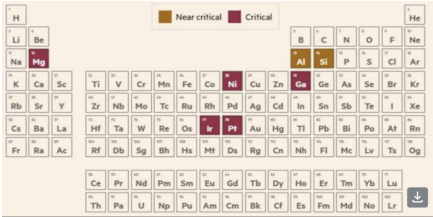
Dozens of naturally occurring elements have become central to industrial production,
technological innovation and national security.
Certain elements are increasingly classified as critical or near critical due to their strategic
relevance, limited supply chains and high exposure to international tensions. As demand rises
across defense, energy transition and advanced manufacturing, these materials are reshaping
global affairs
The periodic table is becoming a strategic map
Three Classes of Strategic Elements
1.Energy Transition Materials
Lithium, nickel, cobalt and rare earth elements are essential for batteries, electric vehicles, wind
turbines and grid infrastructure. Their supply chains are geographically concentrated and
politically sensitive.
2.Industrial and Semiconductor Inputs
Silicon, gallium and other specialty materials underpin semiconductor production and advanced
electronics. Restrictions on export controls or processing capacity can disrupt global
manufacturing ecosystems. Technological sovereignty increasingly depends on control over
upstream material inputs.
3.Defense and High-Performance Alloys
Platinum group metals, rare earth magnets and specialized alloys are indispensable for
aerospace, defense systems and high-performance manufacturing. These materials often come
from politically complex or geographically concentrated regions.
Structural Vulnerabilities
The classification of elements as “critical” reflects three structural risks:
● Supply concentration in a limited number of countries.
● Processing bottlenecks where refining capacity exceeds mining concentration.
● Geopolitical leverage embedded in export controls and trade restrictions.
When industrial ecosystems depend on fragile supply chains, economic competition merges
with strategic rivalry.
Strategic Implications
1.For Global Markets
● Commodity volatility may increase.
● Resource nationalism may intensify.
● Strategic competition may shift toward mineral rich regions.
2.For Governments
● Critical mineral policy becomes part of national security strategy.
● Stockpiling, diversification and industrial partnerships gain urgency.
● Trade policy increasingly intersects with resource access.
3.For Industry
● Supply chain mapping becomes essential.
● Long-term procurement contracts and vertical integration strategies expand.
● Exposure to regulatory and geopolitical risk must be quantified.
The TAMVER Perspective
Critical elements represent a structural shift in global economic power. Control over extraction,
processing and distribution channels is becoming a determinant of industrial sovereignty.
Resilience in this environment requires:
● Diversified sourcing strategies.
● Scenario based geopolitical analysis.
● Transparent governance and compliance structures.
The competition for influence is increasingly embedded in material supply chains.
How TAMVER CONSULTING Helps:
TAMVER CONSULTING supports institutions navigating critical mineral exposure through:
1.Geoeconomic Scenario Design: Modeling supply disruptions, trade restrictions and
regulatory shifts.
2.Supply Chain Exposure Assessment: Identifying concentration risks and processing
dependencies.
3.Strategic Governance Architecture: Aligning procurement strategy with geopolitical and
compliance frameworks.
TAMVER provides clarity where industrial capacity and geopolitical risk intersect.